
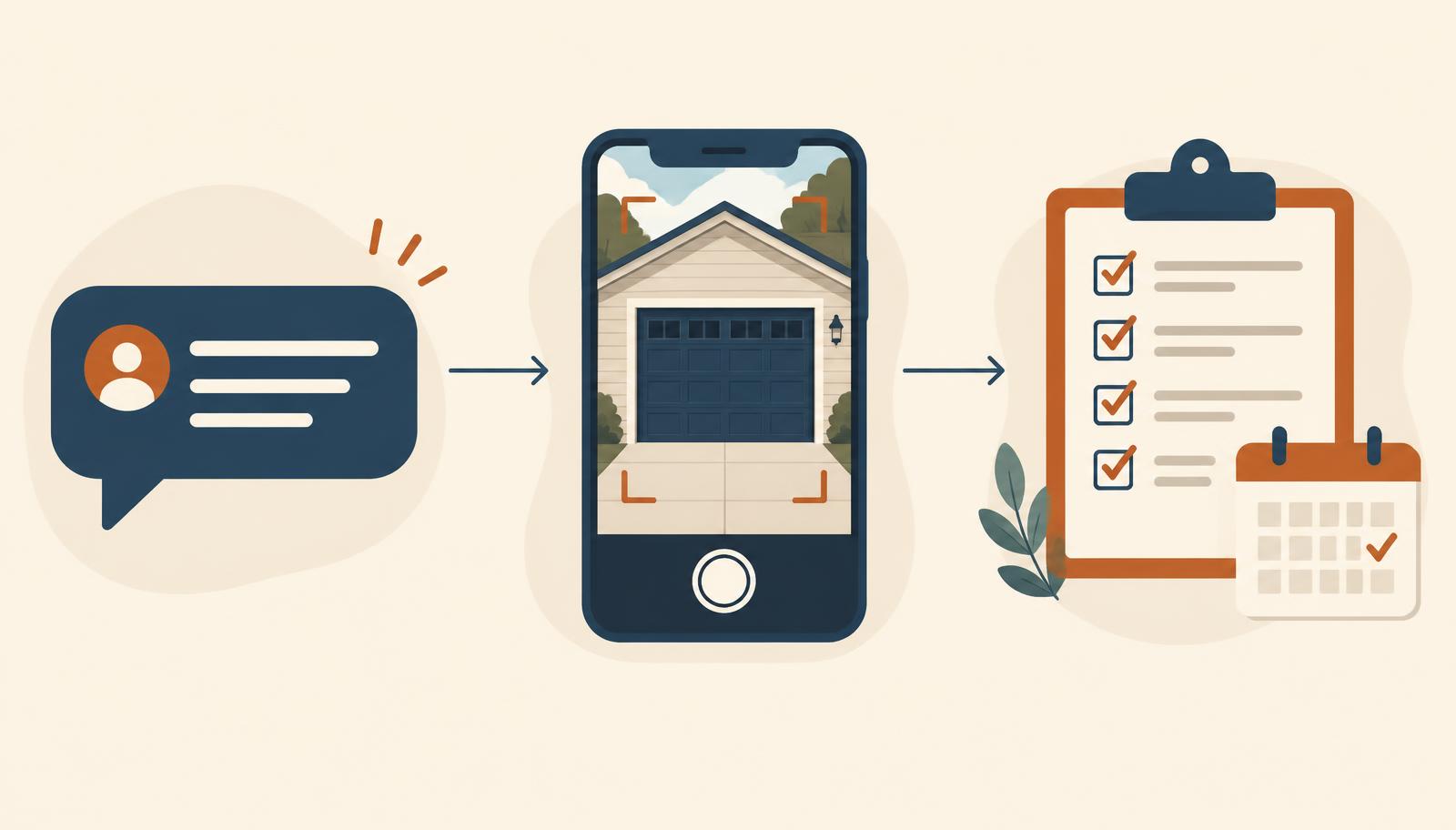
For years, the online customer journey was predictable: search Google, click a website, compare a few businesses, then enquire. In 2026, that journey is starting to fracture. Customers can ask an AI assistant, show Google a photo, compare providers inside an AI answer, or increasingly hand part of the research to an agent. For Australian businesses, being easy to find is no longer enough. You also need to be easy for machines to understand, verify and recommend.
Picture a Brisbane homeowner who notices their garage door has come off its track. A few years ago they would have typed "garage door repairs Brisbane", opened four or five results and called whoever looked most credible.
Today the same person might take a photo and ask what is wrong. They might ask ChatGPT or Google which local companies work on that type of door, ask for a comparison of two providers, or use an AI-powered search experience to narrow the options before they ever visit a website.
“For 20 years, businesses optimised to become a search result. The next challenge is becoming an answer, and eventually the business a system is confident enough to recommend.”
How the path to an enquiry is changing
The old journey
- Search
- Click
- Compare
- Enquire
The emerging journey
- Ask, show or delegate
- Compare and verify
- Act
Search is no longer one box
Discovery in Australia is spreading across traditional search engines, AI assistants, maps, marketplaces and other surfaces. People no longer pick one channel and stay there.
YouGov's 2026 Australian report describes Australians moving between these channels depending on the task. Someone might use Google Maps to find a nearby café, an AI assistant to understand a problem, and a marketplace to compare prices, all in the same week.
The click is becoming less predictable
Visibility and traffic used to move together. That link is weakening.
Ahrefs' February 2026 study of 300,000 keywords found that the presence of an AI Overview correlated with a 58% lower average clickthrough rate for the number one organic result on comparable informational queries. That is a correlation, not proof that AI Overviews caused the whole drop.
Google's position is different. It says AI search experiences are increasing search usage and still sending large volumes of clicks to websites (Google). Both things can be partly true: more searching overall, with fewer clicks on some types of query.
A brand can influence a buying decision even when the AI interaction does not create a clean referral session in GA4. Someone reads an answer, remembers your name, then searches for you directly or calls a week later. Your analytics may record that as branded search or direct traffic, not AI.
It gets messier. Semrush's June 2026 study found that 61.7% of observed AI citations were "ghost citations", where a source was cited but the brand was not named in the answer. Your page can be doing the work while your name never appears.
That is why it helps to separate four things that often get rolled into one vague "AI visibility" score: citations, brand mentions, traffic and enquiries. Each tells you something different.
Ask. Show. Delegate.
Three behaviours sit behind most of the change. They overlap, but each asks something slightly different of your website.
Ask
Full questions, not keywords
People ask for a provider, a comparison, pricing guidance, red flags, recommendations or a shortlist, then keep going with follow-up questions. The answer has to hold up across the whole conversation, not just one query.
Show
A photo becomes the query
Visual search is now measurable. On 24 September 2026 Google added web multimodal performance reporting to Search Console, covering Lens, Circle to Search, image uploads to Google Search and Chrome's Search this image.
Delegate
Systems doing part of the task
At I/O 2026 Google announced broader search agent features, including agentic booking for more local experiences and services, and Google calling businesses on a user's behalf for selected categories.
What "show" means in practice
When a customer can start with a photo instead of typed words, good photography, clearly labelled products and services, image context, useful page copy and technically accessible visual content all matter more. The new Search Console reporting gives site owners a first way to see that activity.
What "delegate" means today
Be careful with this one. The expanded calling rollout described by Google is focused on the United States and should not be treated as broadly available in Australia today. It is evidence of direction, not a sign that Australian customers can already use every feature. The practical takeaway is simple: a system can only book or call you if your details, hours, services and service areas are clear and consistent.
What does this change for an Australian business website?
The website is not becoming less important. It is becoming a structured source of truth for people, search engines and AI systems.
Self-audit
Seven things to get right
None of these are new. They simply carry more weight when a machine may read your site before a person does.
- 1Say exactly who you are, what you do and where you operate.
- 2Give each core service a useful, complete page that answers real buying questions.
- 3Put proof close to claims: reviews, qualifications, case studies, dates, authors, first-hand examples and sources.
- 4Use structured data accurately where it fits the content.
- 5Make pricing, process, eligibility, locations and limitations clear when customers need them.
- 6Keep crawlability, indexation, canonicals, internal linking and site architecture in good order.
- 7Make conversion paths obvious so a person who does click can act quickly.
GEO does not replace SEO
Generative engine optimisation is the work of making a business and its content easier for AI-powered search and answer systems to understand, verify and accurately represent.
Strong GEO mostly builds on strong SEO, content, entity clarity, reputation and technical foundations. There is no separate trick that works without them, and nobody can guarantee a citation, mention, ranking or recommendation.
Semrush's January 2026 study found positive associations between AI citations and clearer summarisation, expertise signals, question and answer formatting, stronger section structure and structured data. Associations are not guarantees, but they point to a sensible principle.
Write for the customer first, but make the answer easy to extract, verify and attribute.
A 15-minute DIY AI visibility check
You can get a useful first read on your own business without paying anyone. These free Launch North tools cover each step.
Free DIY check
Try this with your own business
Run it once now, then repeat it every month or two with the same prompts so you can see what changes.
- 1
Build a realistic prompt set
Generate natural discovery, comparison, cost and trust questions based on your service, audience and location. The tool uses transparent templates, not live AI search data.
- 2
Ask those prompts where your customers ask
Test a repeatable sample in ChatGPT, Google AI Mode or Gemini where available, Perplexity or other relevant systems. Record whether you are mentioned, whether you are described accurately, which competitors appear, which sources are cited, whether the service area is right, and whether anything important is invented or missing. Answers vary by model, date, location and personalisation, so treat this as a repeatable observation, not a permanent ranking.
- 3
Map those prompts back to your website
See which pages answer each prompt well, which only partly answer it, and where you have gaps.
- 4
Check technical and structural readiness
Review crawlability, entity clarity, content structure, trust signals and schema. It does not query ChatGPT, Gemini, Claude or Perplexity and does not give an official AI visibility score. Then check whether robots.txt allows or blocks search, training and user-directed AI crawlers.
- 5
Check whether key pages are easy to quote
Review direct answers, evidence, entity context and technical clarity on your most important pages. Citation readiness is not the same as being cited.
Want to test it yourself? All Launch North marketing tools are free and require no signup.
What should businesses measure now?
- Traditional search visibility: rankings, impressions and search demand.
- AI answer visibility: whether the business appears for a repeatable set of prompts.
- Citation and entity accuracy: whether the right page is cited and the business is described correctly.
- Commercial response: qualified traffic, branded search, calls, forms and enquiries.
There is no single complete dashboard for AI discovery yet. Any tool claiming one number captures it all is simplifying. Track the four areas side by side and look for patterns over months, not days.
The website is not disappearing. Its job is changing.
The website is still where a business controls its facts, its proof, its services, its story and the next step. What is changing is who may read it first.
Sometimes it will be a person. Sometimes it will be Google. Sometimes it will be an AI assistant trying to answer a question. And increasingly, it may be a system helping someone compare or complete a task.
That makes the fundamentals more important, not less: clear information, useful content, strong proof, sound technical SEO and an easy path to enquiry.
The businesses that adapt well will not chase every new AI feature. They will make themselves easier to find, easier to understand, easier to verify and easier to choose.
Sources and further reading
- Google, New opportunities, control and insights for website owners (3 June 2026, updated 31 August 2026)
- Google, A new era for AI Search (19 May 2026)
- Google Search Central, Announcing web multimodal Search performance reporting in Search Console (24 September 2026)
- YouGov Australia, Searching for answers: How AI is changing online discovery in 2026 (8 July 2026)
- Ahrefs, Update: AI Overviews Reduce Clicks by 58% (4 February 2026)
- Semrush, Why 62% of AI citations don't lead to brand mentions (9 June 2026)
- Semrush, How We Built a Content Optimization Tool for AI Search (14 January 2026)